A typical case, not a client
This study does not describe any real clients and does not report any results obtained from a client: our confidentiality commitments prohibit this. It sets out explicit working hypotheses, then derives orders of magnitude through calculations that you can replicate line by line. During a diagnosis, your figures replace ours.
The modelled situation
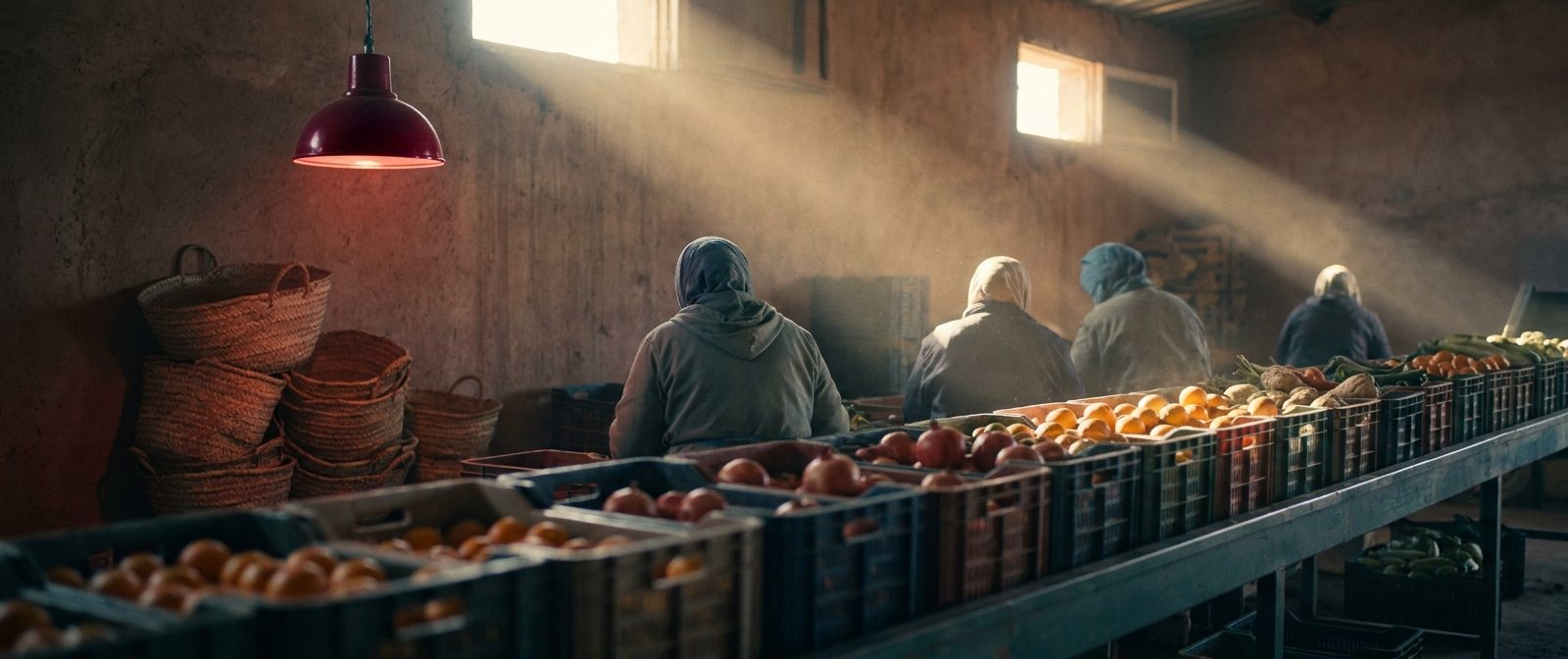
The Moroccan agricultural sector is characterised by a diversity of crops and agricultural practices. Cooperatives, which are emerging as a model of collective management, contribute to the structuring of production and access to markets. However, they face challenges such as limited access to financing, insufficient infrastructure, and growing competition in local and international markets. Additionally, climate change and fluctuations in raw material prices impact the profitability of cooperatives. The above hypotheses allow for the assessment of the current dynamics of the sector and understanding the specific needs of cooperatives.
| Initial hypothesis | Value | Unit |
|---|---|---|
| Member deliveries per campaign day | 45 | deliveries |
| Campaign days | 120 | days |
| Rate of non-compliant batches upon receipt | 6 | % |
| One analysis for every N deliveries | 5 | deliveries |
Result, line by line
The analysis of agricultural cooperatives in Morocco reveals complex challenges that require an integrated approach to be overcome. Training members, accessing financing, and improving infrastructure strengthen the resilience and competitiveness of cooperatives. By adopting adapted strategies, cooperatives can not only improve their economic performance, but also contribute to the sustainable development of the agricultural sector. The involvement of stakeholders, including governments, NGOs and the private sector, creates an environment conducive to the growth of cooperatives.
| Calculated magnitude | Formula | Result | Unit |
|---|---|---|---|
| Volume processed per year | 45 per day × 120 days | 5 400 | units/year |
| Discrepancies observed | 5 400 × 6,0 % | 324 | discrepancies/year |
| Controls to be carried out on the sampling plan | 5 400 ÷ 5 | 1 080 | controls/year |
| Proportion of the flow actually controlled | 1 ÷ 5 × 100 | 20 | % of flow |
What we measure first
Access to financing
Cooperatives face difficulties in obtaining financing suited to their needs, which limits their investment capacity.
Training and skills
A lack of training in management and marketing techniques hinders the performance of cooperatives.
Infrastructure
Transport and storage infrastructure is often insufficient, complicating the distribution of products.
Competition
Increased competition, both in the local and international markets, puts pressure on cooperatives to improve their quality and reduce their costs.
How the mission unfolds
Capacity building
Implement training programmes to enhance management and marketing skills.
Access to financing
Develop partnerships with financial institutions to facilitate access to suitable financing.
Improvement of infrastructure
Collaborate with local authorities to improve transport and storage infrastructure.
Marketing strategies
Develop marketing strategies to enhance the visibility of cooperative products in the markets.
Innovation and diversification
Encourage innovation in agricultural practices and diversification of crops to meet market needs.
The indicators implemented
Identified during the diagnosis and monitored throughout the mission: these are what make the result demonstrable, not just declarative.
- Rate of rejected batches upon receipt, per member
- Delay between harvest and cooling
- Upstream traceability: proportion of identified plots
- Results of residue analyses
- Proportion of members trained in good agricultural practices
What causes this type of project to fail
Lack of coordination+
Resistance to change+
Inadequacy of products+
Low member engagement+
What is being asked of us
How can cooperatives improve their access to financing?+
What are the best practices to strengthen members' skills?+
How to face competition in the market?+
What role does innovation play in the development of cooperatives?+
Let's redo this calculation with your figures
The diagnosis replaces each hypothesis with data collected from you. It lasts half a day and does not commit you to anything.
Request a diagnosis