A typical case, not a client
This study does not describe any real clients and does not report any results obtained from a client: our confidentiality commitments prohibit this. It sets out explicit working hypotheses, then derives orders of magnitude through calculations that you can replicate line by line. During a diagnosis, your figures replace ours.
The modelled situation
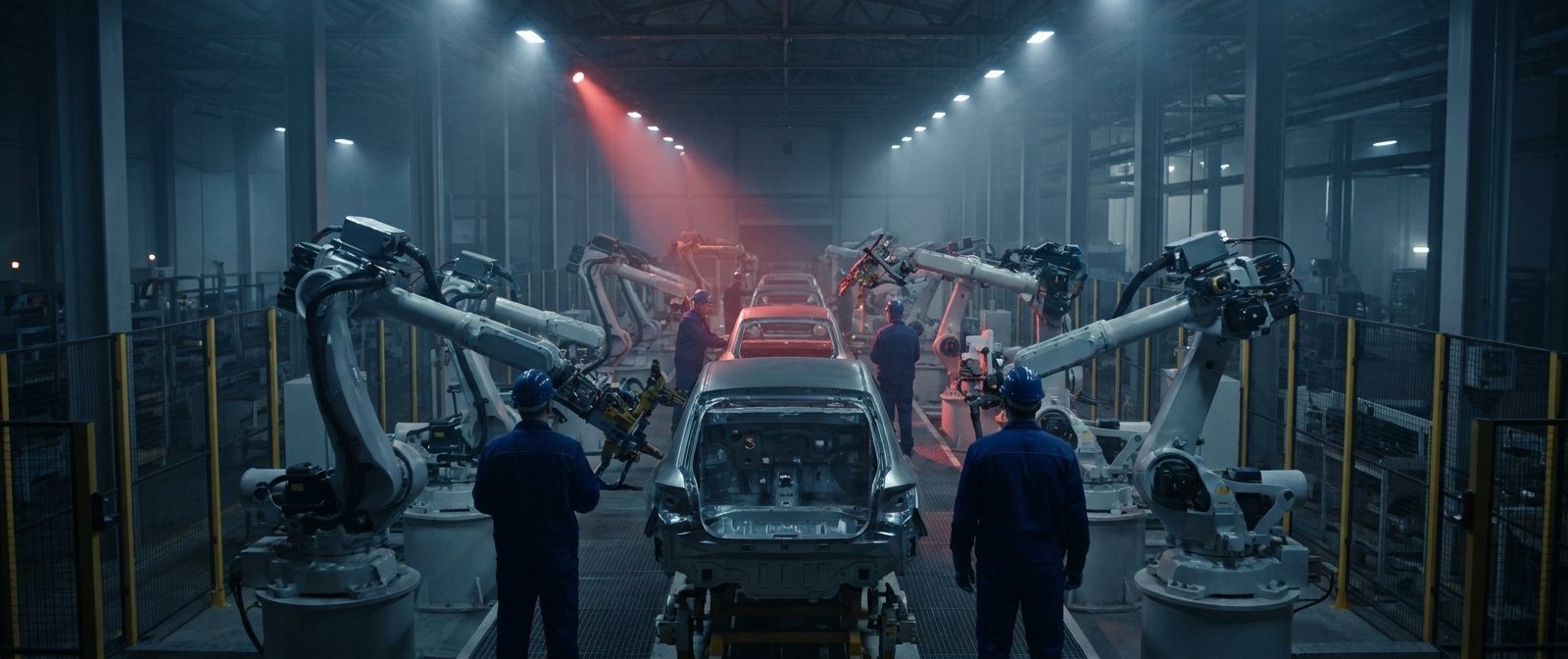
Morocco has established itself as an attractive hub for the automotive and aerospace industry, thanks to a favourable geographical location, developing infrastructure, and government incentives. Companies in the sector benefit from a rapidly expanding ecosystem, with the emergence of industrial clusters and strategic partnerships. However, they must also face challenges such as dependence on imports of raw materials, the need for constant innovation, and the management of qualified human resources. Companies must navigate a competitive environment where cost and quality pressures are omnipresent, while meeting increasing demands for sustainability and corporate social responsibility.
| Initial hypothesis | Value | Unit |
|---|---|---|
| Annual turnover | 90 000 000 | MAD |
| Production workforce | 140 | people |
| Scrap and rework rates | 3,8 | % du CA |
| Treatable share over twelve months | 40 | % |
Result, line by line
This sector case study provides an in-depth analysis of the challenges and opportunities in the automotive and aerospace sector in Morocco. Companies must adapt to a constantly evolving environment by integrating innovation strategies, skills development, and sustainability. By focusing on local sourcing and regulatory compliance, they can strengthen their market position. The proposed recommendations aim to assist business leaders in navigating this complex landscape and maximising their growth potential. Particular attention to talent management and innovation will be essential to ensure the sustainability and competitiveness of companies in this sector.
| Calculated magnitude | Formula | Result | Unit |
|---|---|---|---|
| Annual cost of non-quality | 90 000 000 × 3,8 % | 3 420 000 | MAD/year |
| Treatable share in twelve months | 3 420 000 × 40 % | 1 368 000 | MAD/year |
| Equivalent per person | 1 368 000 ÷ 140 | 9 771,4 | MAD/person |
| Target rate after initiative | 3,8 % − (3,8 % × 40 %) | 2,3 | % du CA |
What we measure first
Dependence on imports
Companies in the automotive and aerospace sector heavily rely on imports of components and raw materials, which can affect their resilience to market fluctuations.
Insufficient innovation
There is a gap in innovation, with an increased need to invest in research and development to remain competitive in the global market.
Talent management
The shortage of skilled labour poses a major challenge for companies, requiring training and skills development strategies.
Regulatory compliance
Regulatory requirements regarding quality and sustainability are becoming increasingly stringent, necessitating companies to adapt their processes and products.
How the mission unfolds
Strengthen local sourcing
Develop partnerships with local suppliers to reduce dependence on imports and support the local economy.
Invest in innovation
Implement research and development programmes to stimulate innovation and product improvement.
Develop skills
Establish collaborations with educational institutions to train a skilled workforce and meet sector needs.
Improve compliance
Adopt quality management systems to ensure compliance with regulatory standards and enhance customer satisfaction.
Promote sustainability
Integrate sustainable practices into production processes to meet consumer and regulatory expectations.
The indicators implemented
Identified during the diagnosis and monitored throughout the mission: these are what make the result demonstrable, not just declarative.
- PPM (defective parts per million) per line
- Synthetic equipment yield rate
- Number of open customer complaints
- Changeover time on bottleneck stations
- Compliance rate with the monitoring plan
What causes this type of project to fail
Lack of strategic vision+
Inability to innovate+
Recruitment difficulties+
Non-compliance with standards+
What is being asked of us
How is Morocco attracting investments in the automotive and aerospace sector?+
What are the main trends in the automotive market in Morocco?+
What challenges must companies overcome to remain competitive?+
How can companies improve their brand image?+
Let's redo this calculation with your figures
The diagnosis replaces each hypothesis with data collected from you. It lasts half a day and does not commit you to anything.
Request a diagnosis